
Home Blog Page 45

Property Inspection Services in Dubai

0
Property Inspection Services in Dubai

Conducting a property inspection is one of the most important steps when purchasing or leasing a property in Dubai. Property inspection Dubai checks the building to ensure it is in good condition and does not belong to any issue needing costly repair. You can avoid headaches and unplanned expenses by undertaking this inspection. A thorough property inspection is always a top priority, whether for a first-time home buyer, renter or investor.

Property Inspection Services Dubai

Dubai Property Inspection Services conduct a thorough investigation of the property. It involves checking the building’s structural integrity, electricity, plumbing, ventilation and general state. Inspections aren’t just about what you see; they reveal underlying issues that aren’t always obvious. The purpose of our property inspection services in Dubai is to ensure that each property facet is checked thoroughly.

With such a competitive real estate market in Dubai, it is important that you are paying for the value you get. If it’s a property you are investing in or looking to move into a new home, property inspections in Dubai will protect your interests and save you from many unpredictable costs down the road.

Property Inspection Company Dubai

Property Inspection Services in Dubai

Selecting a property inspection company in Dubai is as important as the inspection itself. You need a trustworthy, experienced, and dedicated company that can provide thorough inspections. As a leading property inspection company in Dubai, we work to satisfy our customers and provide them with the most exact and reliable information.

On top of such services, we specialize in residential and commercial property inspections. One of our highly trained and high-tech equipped inspectors performs each inspection. Whether moving into a new home or renting office space, we ensure you get a clear view of the property’s condition. We provide comprehensive and professional assessments to protect your investment with our services.

What we check in your Property Inspection?

Property inspections are a critical step in the process of ensuring the safety, quality, and long-term value of property in Dubai. By employing trained inspectors, buyers can pick up on problems that are not visible during a routine property viewing. A thorough inspection gives buyers peace of mind and prevents future costly repairs.

When performing a comprehensive property inspection, there are several important things to be scrutinized:

Structural Stability – Examine the overall building integrity, including for cracks in the deck, sideboards, and roof.

Electrical System – Check that wiring, circuit breakers, and safety devices are up to electrical codes and work properly.

Plumbing – Check that pipes, fixtures, and water pressure are in good working order and meet plumbing standards.

HVAC System – Check heating, ventilation, and air conditioning systems for efficiency, effectiveness, and whether any maintenance would be needed.

Exterior and Interior Review – Inspect the entire property to detect flaws, damages, or structural vulnerabilities that would need adjustment or repairs.

A diligent property inspection prevents buyers from making uninformed purchases, protecting their investment and a home that’s safe and quality-wise.

How to Find the Best Property Inspection Services in Dubai?

Zia Property Luxury Observer is among the companies offering Dubai’s best property inspection services. Our well-trained inspectors guarantee that the properties we inspect meet the highest quality standards. Whether you have a small apartment or a complex commercial property, we offer a full inspection that includes every property element.

We are flexible and adjust our property inspection services based on your needs. We provide services specific to your needs, whether you are a property buyer, investor, or tenant. Our inspectors are thorough and never fail to leave anything unnoticed. You can be assured that you are safe regarding our property inspection services in Dubai.

Our property inspection services are designed to be flexible according to your needs. Whether you are a property buyer, investor, or tenant, we offer services specific to your requirements. Our inspectors take the time to ensure that nothing is ignored. With us, you can be confident that you’re receiving Dubai’s best property inspection services.

Regulation of Inspections and Safety in Dubai

The regulation of property inspection and safety in Dubai is guided by stringent building regulation and guidelines by regulatory bodies like the Dubai Municipality and the Real Estate Regulatory Authority.

The laws have the effect of ensuring that all domestic and commercial properties meet international safety levels, structural soundness criteria, and sustainability standards.

Regular examinations are required at different stages of construction to ensure compliance with fire safety, electrical, water, and structural rules, lowering the hazards involved with substandard construction or poor maintenance. Besides construction regulations, building regulations in Dubai also follow regular property inspections of existing buildings for compliance and safety.

Periodic assessments need to be done by property owners and developers to comply with health, safety, and environmental (HSE) regulations. Noncompliance with these regulations may attract penalties, fines, or even property usage restrictions.

Through enforcing these strict controls, Dubai is seeking to provide high-quality infrastructure, increase the value of real estate, and ensure safer residential and working environments for residents and businesses alike.

Why Choose Zia Luxury Property Observer for Inspection in Dubai?

We provide the best results by many property inspection companies in Dubai because we are dedicated to our work. Our commitment is to provide transparent, reliable, and efficient services according to the best standards.

With Zia Property Luxury Observer, you’re working with a team of property inspection experts who care about the details.

We also provide timely reports and excellent customer support during the inspection process. We’re here to help you every step of the way by answering questions or explaining our findings.

Conclusion

Whether buying, selling or simply investing in a property in Dubai, conducting a property inspection is essential. It gives you peace of mind and avoids all those unexpected costs in the future. Zia Property Luxury Observer is a name you can rely on for your property inspection in Dubai. Here we provide property inspection services in Dubai to ensure that you confidently take your decisions. So, trust our expert team who offer you complete, professional and reputable property inspections.
Al Hilal Bank Office Tower: A Symbol of Contemporary Architecture in Abu Dhabi

0

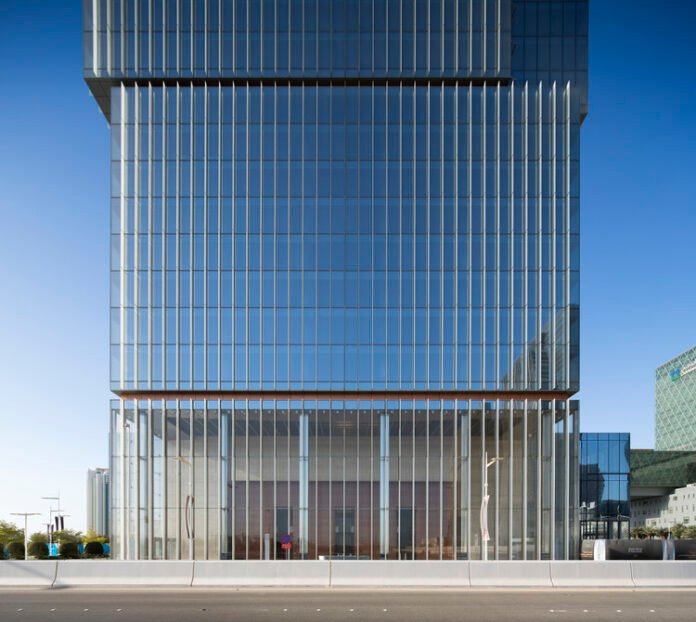
Located on Al Maryah Island in Abu Dhabi, the Al Hilal Bank Office Tower is a symbol of creative design and environmentally friendly architecture. As the anchor commercial development for Al Hilal Bank, this 24-story tower nicely marries contemporary beauty with functional superiority

Architectural Design

Conceived by the renowned architecture firm Goettsch Partners, the tower’s design is defined by its unique shifting massing. The building consists of three cubic volumes stacked with minor offsets, resulting in a dynamic “push-and-pull” effect at the corners. Not only does this design strategy set the building apart from other towers on Al Maryah Island, but it also yields efficient, column-free interior spaces.

The façade is clad in an aluminum-and-glass curtain wall system and is supported by notched metal spandrels and vertical glass fins. Such details add emphasis to the building’s vertical element while providing quiet shading, reinforcing its classic yet sophisticated look.

Sustainable Features

Reflecting its environmental commitment, the tower received an Estidama 1 Pearl sustainability rating. Sustainable design elements include exterior shading, high-performance glazing, and energy-efficient equipment for lighting, heating, cooling, pumps, and fans, which translate to an overall energy savings of 12 percent. An integrated water strategy reduces interior potable water use, further reflecting the building’s environmentally responsible design.

Interior and Amenities

The interior has close to 68,000 square meters of gross floor area with Class A office and retail areas created to lure top national and global corporations. Amenities such as column-free, efficient floor plates and floor-to-ceiling glass windows allow the occupants to enjoy amazing views and a wealth of natural light.

A landscaped park and reflecting pool on the western façade create a welcoming, shaded urban space, making the building more attractive to tenants and visitors alike.

Read This Article: Business Central Towers: A Landmark in Dubai’s Commercial Landscape

Recognition and Awards

The Al Hilal Bank Office Tower has won numerous awards for its sustainable design and architectural merit. Among its notable achievements is the 2016 Middle East Architect Award for Commercial Project of the Year, where the jury commended its sleek design and careful attention to detail.

Moreover, the tower was a 2015 Best Tall Building Award finalist by the Council on Tall Buildings and Urban Habitat, further solidifying its place in the pantheon of architectural landmarks.

Al Maryah Tower - DeSimone Consulting Engineering

Conclusion

The Al Hilal Bank Office Tower is an eloquent embodiment of the harmonious integration of state-of-the-art design, environmentally friendly practices, and utilitarian excellence. As a distinguishing landmark of Abu Dhabi’s profile, it is not just a headquarters for Al Hilal Bank but also a source of inspiration for regional modern architectural triumph.

Historical Importance of Al Hilal Bank Building

Al Hilal Bank Building occupies a special place in the historical context of the United Arab Emirates, especially in terms of banking sector growth and Abu Dhabi economic development. Following are some major points about its historical importance:

1. Establishment of Al Hilal Bank

Year of Founding: Al Hilal Bank was founded in 2008, when the UAE economy was witnessing high-speed growth and diversification. This was a crucial period for the UAE as it attempted to become a financial center in the world.

Vision for Islamic Banking: The bank was established to offer Sharia-compliant banking products, leveraging an increasing need for Islamic financial services. This was important in consolidating the UAE’s position as a leader in Islamic finance globally.

2. Architectural Milestone

  • Contemporary Architecture: Completed in 2012, the Al Hilal Bank Building signifies a move towards contemporary architectural traditions in the UAE. The design focuses on sustainability and innovation as per the aspirations of the nation towards a greener future.
  • Cultural Blend: The structure blends aspects of Islamic traditional architecture, reflecting the blending of heritage with modernity. This captures the UAE’s overall historical narrative of reconciling tradition and innovation.

3. Economic Growth Catalyst

Financial Sector Expansion: Opening of Al Hilal Bank and the location of its headquarters represented a major expansion of the banking sector in Abu Dhabi. As the bank expanded, it helped to diversify the economy and shift it from a dependence on oil revenues only.

Job Creation and Investment: Al Hilal Bank Building has been a source of job creation in the financial services industry, bringing in talent and catalyzing investment in the area. This has triggered a ripple effect in the local economy.

4. Community Impact

  • Social Responsibility Activities: Al Hilal Bank has also undertaken numerous community activities to foster financial awareness and contribute to local charities, thus emphasizing its social responsibility commitment—a key element of Islamic banking philosophy.
  • Cultural Events and Interaction: The building frequently houses events which unite business executives, policymakers, and community members, promoting a culture of interaction and debate in the UAE.

Conclusion

The Al Hilal Bank Building is not only an architectural wonder; it is a landmark of historical importance that speaks to the development of the banking industry in the UAE. It represents the nation‘s adherence to Islamic finance, diversification of the economy, and fusion of tradition and modernity. As the UAE develops and expands further, the significance of this building in its history will become even more profound.

Business Central Towers: A Landmark in Dubai’s Commercial Landscape

0

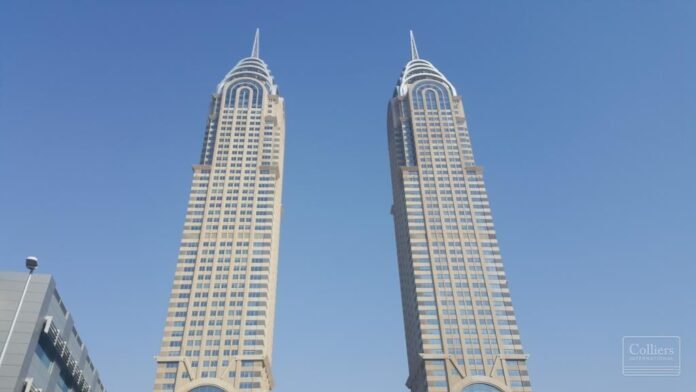
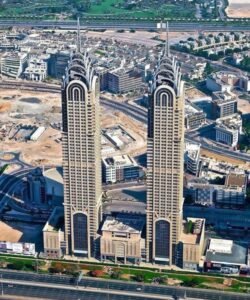
Business Central Towers: A Dubai Icon in the Business District Located on Dubai’s busy Sheikh Zayed Road, the Business Central Towers are a reflection of the city’s rapid growth and architectural advancement. The twin towers, situated in the center of Dubai Media City, are now a landmark offering a mix of contemporary design and strategic positioning.​

Architectural Overview

The Business Central Towers are made up of two 53-story buildings, each measuring a height of 265 meters (869 feet). The towers have a modern design with a symbiotic combination of stone and glazing finishes, mirroring Dubai’s dedication to innovative design. The complex, designed by the National Engineering Bureau, consists of 470 office units and 19 retail units to serve a variety of businesses.

Prime Location

Situated within Dubai Media City, the towers benefit from unprecedented accessibility to prime commercial destinations. Its proximity to Sheikh Zayed Road guarantees hassle-free connectivity to many areas of the city, presenting a highly coveted choice for organizations in pursuit of a distinguished location with prime accessibilities.

Facilities and Amenities

Business Central Towers provide a myriad of facilities intended to augment the office experience:

    • Dedicated Parking: There are sufficient parking spaces for tenants and visitors.​
    • Retail Outlets: A separate retail space offers easy shopping and dining.​
    • Security Systems: High-tech security systems provide a secure and safe setting.​
    • Health Club and Pool: A large health club and swimming pool meet the well-being needs of residents.​
  • Elevators: Individuals can find multiple spacious and high-speed elevators in Business Central Tower A.
  • Fitness Amenities: There is a sauna/steam room and swimming pool in this building. For a gym in Business Central Tower A, one can visit nearby gyms.

Business Ecosystem

The towers have diverse businesses that include digital marketing companies to advisory services. Worth mentioning is the presence of organizations such as Maveric Systems and VAP Digital Media, whose offices are set within the complex. This supports the vibrant business community of the complex.

Read This Article: How 5G Is Changing Digital Life in the Gulf

Business Central Towers in Dubai Via the Metro

To get to the Business Central Towers in Dubai via the metro, follow these instructions:

Take the Red Line:

  • Starting from wherever you are in Dubai, board the Dubai Metro Red Line.

Exit at the Dubai Metro Station:

  • This is the nearest metro station to the Business Central Towers. The ride is easy and straightforward, and the station is only a few minutes’ walk from the towers.

Leave the Metro Station:

  • After you come out of the metro station, go in the direction of the Dubai Media City district. The Business Central Towers are located here, and it is roughly a 5-minute walk from the station.

Travel Tip: Ensure that you verify the current schedule and metro hours for hassle-free travel. Alternatively, download the Dubai RTA app for live updates and route management.

How Far is this from Burj Khalifa

The Business Central Towers are situated some 15 kilometers (roughly 9 miles) from Burj Khalifa.

By road, it would take between 15 and 20 minutes, depending on traffic. Using the metro, you can go from Burj Khalifa/Dubai Mall Metro Station to Dubai Internet City Metro Station using the Red Line, which would take around 20 minutes with a changeover at one of the major metro stations, e.g., Financial Centre. It’s then just a short walk to the Business Central Towers.

Restaurants Near Business Central Tower

Restaurants around Business Central Tower A provide diverse cuisines, from healthy café food to traditional Asian and Mexican dishes. Brisk, which is on the ground floor, is a warm café that specializes in healthy and tasty meals, such as Moroccan chicken, grilled chicken, avocado toast, mashed potatoes, and fresh salads. It is well-liked for its plentiful portions and cozy atmosphere, providing a wonderful area for relaxed eating. The typical price for two individuals is roughly AED 110, with both cash and card transactions accepted. In addition, Brisk is wheelchair friendly, has free Wi-Fi, and has a child-friendly atmosphere.

  •  Little Bangkok, also on the ground floor, provides a blend of traditional and contemporary. Thai and Asian food. Popular dishes among customers are noodles, tom yum soup, pad Thai, Thai red curry, and seafood. The restaurant, which is operational from 12 PM to 11:30 PM, is valued for its themed setting, warm ambiance, and vegan menu. At an estimated price of AED 195 for two, it also offers home delivery, wheelchair accessibility, and free Wi-Fi. 
  • Taqado Mexican Kitchen, which is only **3 minutes from the location, provides budget-friendly and fresh Mexican food including Guacamole, Burritos, Quesadillas, and Churros. This restaurant, which is famous for its lively flavors, is priced at approximately AED 50 per person and also features facilities like a vegan menu, kid-friendly environment, free Wi-Fi, wheelchair access, and valet parking. For nightlife in the vicinity of Business Central Tower A, there are quite a few thrilling choices.
  • Grand Lounge: situated 7 minutes away, is a popular bar with a vast array of wines, cocktails, mocktails, and champagne** available, along with plenty of **finger foods** to accompany the drinks. 

Bongo’s Bingo (4 minutes away) and Twenty Three (5 minutes away), which offer an exciting and humorous experience for travelers seeking relaxation after a busy day.

History 

The Business Central Towers in Dubai stand out in the modern skyline of the city and are representative of the swift expansion of business and commerce in Dubai. A brief history of the towers is as follows:

Development and Construction

The Business Central Towers formed a part of Dubai’s strategic plan to develop its commercial infrastructure and invite international businesses to the area. The twin towers were constructed by National Engineering Bureau (NEB), a firm with a reputation for architectural design and engineering solutions.

Strategic Location in Dubai Media City

The towers were constructed in Dubai Media City, a major business district in the city. Dubai Media City opened in the early 2000s as a location where media, advertising, and tech businesses would be converged. The construction of the Business Central Towers in the area was part of a larger effort by Dubai to diversify the economy away from petroleum and into business services, tech, and media.

Completion

Business Central Towers were completed during the mid-2000s, when Dubai was in the midst of a huge construction boom. This was the time when several high-rise towers were being constructed to meet the increasing numbers of international companies immigrating to the city.

Architectural Design

The towers were built with contemporary and sleek architecture, featuring modern glass and stone facades that symbolize Dubai’s progressive style of design. Standing at 53 stories tall, the towers are impressive in terms of size and visibility along the congested Sheikh Zayed Road, a major thoroughfare in the city.

Role in Dubai’s Business Growth

Impact on Growing Dubai’s Business Landscape Over the years, the Business Central Towers have developed into a house to an array of corporates, especially those in the media, finance and technology sectors as a result of their prime location in Dubai Media City placing them at the epicenter of commercial activity in the city, thus playing a vital role in Dubai’s position as a global business gateway.Today, the towers stand as monuments to Dubai’s transformation into an international-class business hub, as a monument to the city’s vision of itself as an international commerce, technology, and innovation hub.

Conclusion

The Business Central Towers are a testament to Dubai’s vision of developing world-class commercial hubs that promote business development and innovation. Strategically located, equipped with world-class facilities, and a cosmopolitan business community, the towers remain at the forefront of shaping Dubai’s commercial landscape

How 5G Is Changing Digital Life in the Gulf

0
How 5G Is Changing Digital Life in the Gulf

INTRODUCTION

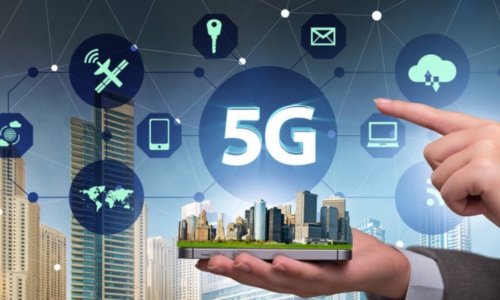
The Gulf region is revolting with the introduction of 5G technology that promises to carry the digital life of unprecedented speed, connectivity, and innovation. Among the countries that are ahead of the curb when it comes to deploying high speed internet are the UAE, countries like Dubai are introducing the new ways of living and bringing the new industries in the Middle East. Whether it is augmenting methods of e-commerce, improving public services, or enabling smart cities, 5G is providing the future: a more connected, more technologically advanced one.

As Gulf nations attempt to shift economies no longer based on oil, Dubai and other major cities have become a force for technology as an economic growth driver and engine of digital transformation. Faster and more reliable internet is also allowing businesses, healthcare, education and entertainment sectors to thrive. At the same time that these services are improving, so to are challenges like cybersecurity, expanding infrastructure and digital inclusion.

This blog takes a look at how 5G UAE is rewriting digital experiences; accelerating economic development and paving the way for a more connected, smarter Gulf.

5G technology is spreading its wings across the Gulf region including cities such as Dubai, with the advent of 5G technology reshaping the digital life in the region, with the United Arab Emirates (UAE) the front runner. Unprecedented internet speeds, better connectivity and exploding number of smart technologies have been transforming the region digitally, and this transformation is happening at pace unlike any other.

5G IN THE GULF: AN OVERVIEW

Several rather than none, including the Gulf Cooperation Council (GCC) countries were first to adopt 5G. These nations are expected to have a 47 percent 5G subscription penetration by 2024, attesting to the fact that the plank of embracing advanced technologies is firmly in place. Part of a wider move to transform oil dependent economies into knowledge based societies so that it can provide a better public service and diversify their economies.

5G Significantly Enhanced Experience for Tourists and Business ...

UAE’S LEADERSHIP IN 5G DEPLOYMENT

The UAE is leading the world in the implementation of 5G. du telecommunications providers reported that 98.5 per cent of the population is 5G covered in the country and establishing a comprehensive and robust network infrastructure. The abundance of coverage makes it possible to deploy the most advanced technologies and services, placing the UAE on the top in 5G speed rankings worldwide.

Read This Article: The Impact of Blockchain in Gulf Finance: Revolutionizing the Future

HIGH-SPEED INTERNET IN THE MIDDLE EAST

Adoption of high speed internet to the GCC countries, particularly the Middle East has grown by leaps and bounds. This piece is key to the region’s smart shift away from oil-dependent economies to knowledge based economies. It helps to increase the public services and economic diversification that these nations aspire to.

TECHNOLOGICAL ADVANCEMENTS IN DUBAI

As a leading smart city, in the Dubai, 5G technology has been taken into use to improve urban living. Written infrastructure, governance and services of the city are due to the commitment to technological innovation by the city, and all of those are more and more growing dependent on high speed internet and more intelligent complex communication networks. Since 5G and the Internet of Things (IoT) become the new wings to power growth and bring innovation across parts, it aims to a smarter city.

IMPACT ON VARIOUS SECTORS

  • Healthcare: With telemedicine, 5G makes it possible to have real time consultations, which also leads to remote surgeries improving the accessibility and efficiency of healthcare.
  • Education: With enhanced connectivity, this enables e-learning platforms, virtual classrooms and access to marketable global educational resources, as well as motivating education.
  • Transportation: 5G’s low latency and high reliability facilitates the development of Autonomous Vehicles as well as smart traffic management systems which will in turns result to safer and more efficient transportation networks.
  • Entertainment: Streaming services, online gaming and virtual reality experiences become enriched with only high speed internet.
  • Business: These cloud computing, IT and communication efficiencies help companies innovate, streamline operations.

CHALLENGES AND CONSIDERATIONS

The quick acceptance of 5G faces ongoing difficulties due to problems relating to network expansion and cyberattacks and internet access inequalities between city and countryside populations. To achieve maximum benefits from 5G technology throughout the region it becomes essential to resolve these existing problems.

Incentivising UAE's fintech boom - The Banker

FUTURE PROSPECTS

The Gulf region remains dedicated to technological development which indicates that 5G will become essential for everyday life to boost economic growth and improve living standards. The ongoing development of infrastructure creates immense opportunities for 5G technology to serve artificial intelligence and smart cities applications and many others.

5G technology serves as the digital transformation engine in the Gulf region under the leadership of the UAE and Dubai. High-speed internet adoption throughout different sectors drives modernization as it creates a path toward fuller digital capabilities of the future.

5G AND ECONOMIC GROWTH IN THE GULF

The economic transformation of Gulf countries heavily depends on 5G technology implementation. Economic diversification occurs through 5G technology which delivers rapid communication methods enabling business productivity improvements and helping develop new industrial sectors including AI and IoT. The Gulf countries follow Saudi Arabia’s Vision 2030 and the UAE’s National AI Strategy as part of their regional initiatives. 5G connectivity better connects Gulf countries to global investors who choose to invest in next-generation technology sectors to strengthen their economic expansion

ROLE OF 5G IN SMART CITIES DEVELOPMENT

The integration of traffic management with energy efficiency and public safety services within smart cities depends on complete connectivity that 5G provides for efficient smart urban infrastructure. The 5G network in Dubai enables AI-controlled monitoring systems as well as automated transportation and intelligent grid management which enhances security together with ease-of-use in daily routines.

ENHANCING CYBERSECURITY IN A 5G-CONNECTED WORLD

As 5G networks expand across the network the number of potential cyber threats rises as well. A larger number of connected devices results in expanded security vulnerabilities. Nation-states within the Gulf region dedicate funds to develop modern cybersecurity systems that safeguard their infrastructures and businesses and personal information from cyber attacks. Digital assets receive protection through new technologies that integrate AI security solutions and blockchain authentication protocols and encryption advancement models.

THE FUTURE OF WORK WITH 5G TECHNOLOGY

People worldwide are transforming their work habits because of 5G. 5G technology enables business members to work remotely and conduct virtual meetings and host cloud computing which results in higher organizational flexibility. The implementation of 5G enables healthcare facilities and financial institutions and manufacturing facilities to perform automatic tasks while conducting remote operations and facilitating real-time work collaborations. The UAE sees many organizations implementing digital workplaces through 5G technology in order to increase both productivity and employee engagement.

5G’S IMPACT ON E-COMMERCE AND DIGITAL PAYMENTS

The increased speed of internet connections through 5G supports online shopping by enabling efficient monetary transactions while providing refined video demo displays and complete augmented reality shopping experiences. Moreover, this network technology enhances digital payment processing speed while providing improved security measures. Gulf countries and the Middle East region experience an expanding trend of cashless transactions through national promotion of digital wallets and blockchain-based payment technologies.

Telecom sector: a driver of economic growth – Pakistan & Gulf ...

SUSTAINABILITY AND ENERGY EFFICIENCY IN 5G NETWORKS

The design specifications for 5G network systems make them consume less energy than prior network generations. The region is using investments to deploy green technology which can lower the emission levels of telecommunication infrastructure systems. Modern smart grids together with automated resource management coupled with renewable energy-driven eco-friendly data centers have become regular practice. The reduced energy consumption enabled by 5G supports environmental sustainability targets in Gulf countries.

THE PROMISE OF 5G: REVOLUTIONIZING DIGITAL CONNECTIVITY IN THE GULF

In this part the author outlines how 5G technology will change digital connectivity in the Gulf region. The paper would describe how 5G technology provides fast internet access and reliable low-latency performance which enables connections for billions of devices making possible a digital connected society. Daily life together with business operations and infrastructure management will improve as a result of the anticipated alterations assessed in the section.

UAE’S LEADERSHIP IN 5G DEPLOYMENT: A GAME CHANGER FOR THE REGION

The 5G network deployment in the region is headed by the UAE which stands among major leaders. The heading demonstrates that the UAE now serves as a worldwide model for 5G implementation while companies such as du and Etisalat take the lead. The section would present detailed information about network deployment covering specifics of speed improvements, coverage areas and their effects on retail along with healthcare and entertainment industries.

5G AND THE TRANSFORMATION OF DUBAI INTO A SMART CITY

Dubai continues to develop into a complete smart city by employing 5G technology as part of its extensive technological vision. This area demonstrates how real-time data processing, smart infrastructure development and traffic management implementation and advanced public service delivery achieve their milestones through 5G technology. The piece examines specific 5G-driven projects in Dubai which enhance city living along with public safety improvements and operational efficiencies of the city.

The section analyzes how high-speed internet affects the Middle Eastern region.

The section examines how the Middle East benefits from 5G powered high-speed internet in its wider scope. The research will analyze how fast internet revolutionizes all regions including urban centers as well as unreachable rural communities. The research examines how swift internet connectivity creates easier information access that promotes digital education and business performance and drives e-commerce growth across multiple business sectors.

5G AND THE FUTURE OF BUSINESS: A NEW ERA OF INNOVATION

The arrival of 5G technology establishes a new phase of business innovativeness that both enhances operational effectiveness and delivers superior client engagements. The section will explain how Gulf businesses utilize 5G technology for operational innovation that includes advanced supply chain management and automated processes and enhanced digital offerings. The section would analyze how 5G helps industries implement both IoT and AI systems.

HOW 5G IS ENHANCING USER EXPERIENCES IN ENTERTAINMENT AND MEDIA

Entertainment and media fields are reshaping their operations because of 5G technology advances. The fast internet speeds provided by 5G enable users to stream high-definition content and experience virtual reality and augmented reality technology alongside other immersive experiences in media consumption. 5G technology will be examined for its benefits to Gulf region gaming as well as its impact on live productions and social media content creation.

Forex Trading Software: Top Picks for Your Capital Gain | MilesWeb

OVERCOMING THE CHALLENGES OF 5G ADOPTION IN THE GULF REGION

The Gulf region takes the lead in 5G adoption yet producers face three significant challenges which combine the development of infrastructure with cybersecurity risks and digital inequality matters. The section will explore the main difficulties governments along with private entities encounter when they implement 5G network deployment. The proposal would handle important matters concerning substantial infrastructure funding as well as privacy protection together with full citizen system accessibility.

WHAT 5G MEANS FOR THE FUTURE: VISIONARY OPPORTUNITIES IN THE GULF

This segment anticipates future prospects by studying visionary opportunities that 5G will provide to the Gulf region. The long-term effects of 5G technology on autonomous vehicles and new industry developments and healthcare and education innovations will be examined. The part would demonstrate that 5G represents more than improved technology because it serves as a foundational power that drives future economic structure and social progress in Gulf nations.

CONCLUSION

The Gulf region is undergoing fundamental digital changes through 5G technology infrastructure while the United Arab Emirates stands as its primary power in network deployment initiatives. As Dubai transforms into a leading smart city 5G provides the base which enhances business operations in various industries to build a future that is both innovative and efficient and connected.

The broader adoption of 5G UAE will create multiple economic expansion opportunities in combination with improving technology accessibility and better user experience standards across the region. The technological improvements through 5G enable better routine living and create fresh commercial potentials which benefit healthcare alongside entertainment and retail sectors. The integration of 5G will advance economically while addressing crucial barriers regarding cybersecurity together with infrastructure development and accessibility needs extensive governmental and business monitoring.

5G technology will reshape digital experiences in the future by transforming the Gulf region into a leader of technological advancement. Continuous technological progress provides extensive possibilities to develop AI together with IoT and autonomous vehicle infrastructure and additional systems. This next-generation connectivity adoption by the Middle East will create a faster smarter and more sustainable future than has ever existed before.

The Impact of Blockchain in Gulf Finance: Revolutionizing the Future

0

As blockchain technology rapidly transforms different industries across the globe, the same is taking place in the financial sector in the Gulf region. Blockchain is a critical part of the digital transformation of nations such as the UAE where it is helping to redesign the way financial operations are conducted, ensuring security, transparency, and efficiency. Blockchain is playing a huge role in Gulf finance from cryptocurrencies to decentralized finance (DeFi) and is creating a future and robust financial system and we will discuss its impact on Gulf finance, its involvement in crypto business in the Middle East and the way Fintech in Dubai is evolving with the innovations of blockchain.

Table of Contents

Understanding Blockchain Technology

Blockchain is a decentralized digital ledger that records transactions across multiple computers, making it secure, transparent, and immutable. Unlike traditional financial systems that rely on centralized authorities like banks, blockchain enables peer-to-peer transactions with enhanced security.

Key features of blockchain technology include:

Decentralization – The network does not have any single entity that is in control of the network.

Transparency –  All transactions are visible and verifiable.

Security –Cryptographic encryption prevents fraud and cyber threats.

Efficiency –and automated transactions reduce processing time and costs.

The Role of Blockchain in Gulf Finance

Blockchain has been adopted by the financial sector in the GCC countries, especially by the UAE and Saudi Arabia. From digital payment to smart contract, governments and financial institutions are using blockchain for different applications.

1.   Enhancing Financial Security and Transparency

The biggest advantage of blockchain in Gulf finance is its ability to provide higher security and transparency. As cyber threats and financial frauds are on the rise, blockchain guarantees all transactions are encrypted and immutable, which almost impossible for records to be altered or fraud committed.

2.   Digital Banking and Payments

In the Gulf, banks and fintech companies are increasingly bringing blockchain into their system to provide seamless digital banking and payment solutions. For instance, the Dubai Fintech is applying the blockchain technology to make cross border payments cheaper by reducing transaction cost and processing times.

3.   Smart Contracts for Automated Transactions

Smart contracts, which are self-executing agreements coded on the blockchain, are transforming the Gulf’s financial sector. They eliminate the need for intermediaries, reducing administrative costs and increasing efficiency. This is particularly beneficial for trade finance and real estate transactions.

4.   Cryptocurrency Adoption in the Middle East

Meanwhile, the UAE is leading the charge in crypto business in the Middle East. The legal recognition of cryptocurrency trading and blockchain products are also growing, with Dubai’s Virtual Assets Regulatory Authority (VARA) being one such example. Nowadays, many businesses and investors are taking crypto assets into consideration as part of their portfolios.

5.   Blockchain-Based Stock Trading

The Gulf stock exchanges are looking into blockchain for faster and more secure trading. Through blockchain, stock transactions can be settled instantly and reducing the risk of fraud and manipulation. Blockchain is already being used in the UAE’s stock markets to improve the market efficiency.

Blockchain UAE: Government Initiatives and Regulations

The UAE government has been a big supporter of blockchain adoption. To further digitize 50 percent of government transactions through blockchain, it launched the Emirates Blockchain Strategy 2021. Some key initiatives include:

Dubai Blockchain Strategy – Its aim is to turn Dubai into a global blockchain hub.

UAE Pass – a national digital identity system based on blockchain.

Blockchain– Healthcare and Supply Chain Solutions – Used for data security and efficiency. The UAE has laid down a clear legal framework for regulating crypto business in the Middle East to protect investors and maintain financial stability.

The Future of Blockchain in Gulf Finance

As Fintech is advancing rapidly in Dubai and around the Gulf, there seems to be a promising future for blockchain. The future will be shaped by the following key trends:

Central Bank Digital Currencies (CBDCs) – As Fintech is advancing rapidly in Dubai and around the Gulf, there seems to be a promising future for blockchain. The future will be shaped by the following key trends:

Decentralized Finance (DeFi) – More financial services will shift to blockchain-based decentralized platforms.

Blockchain for KYC and AML Compliance – Banks will use blockchain to enhance security in Know Your Customer (KYC) and Anti-Money Laundering (AML) processes.

Tokenization of Assets – Real estate, gold, and stocks will be tokenized on blockchain platforms for fractional ownership.

Decentralized Finance (DeFi): Revolutionizing the Future of Financial Systems" - Global Trade Magazine

How Blockchain Is Revolutionizing the Gulf’s Financial Sector

The second part of this section will explore how blockchain is changing the financial operations in the Gulf region. It will show the main advantages of blockchain technology (security, transparency and efficiency), and describes how the major financial institutions start to adopt blockchain technology.

Read This Article: Complete guide on Modern vs Traditional Hotels Interior Designs in Dubai

The Rise of Crypto Business in the Middle East: Trends and Challenges

This part will highlight the rise of cryptocurrencies in the Middle East in general, and in the UAE and Saudi Arabia in particular. It would cover regulatory developments, market trends and challenges faced by businesses and investors in crypto adoption.

Fintech in Dubai: How Blockchain Is Driving Financial Innovation

Dubai is a leading fintech hub in the Gulf and blockchain is an important part of fintech innovation here. In this section, we will see how fintech companies in Dubai are employing blockchain in digital banking, payments, and the decentralized finance (DeFi).

Government Initiatives for Blockchain Adoption in the UAE

Several blockchain initiatives have been launched by the UAE government to facilitate the digital transformation. We will discuss in this section projects such as Emirates Blockchain Strategy, Dubai Blockchain Strategy and regulations for virtual assets and cryptocurrency.

Future of Blockchain in Gulf Finance: Key Trends to Watch

In the latter part of this, we would look at how blockchain trends in the Gulf’s financial sectors will look, especially, Central Bank Digital Currencies (CBDCs), decentralized finance, blockchain based stock trading and tokenization of assets.

How Businesses and Investors Can Leverage Blockchain in the Gulf

The final section will provide practical guidance for businesses and investors interested in applying blockchain in the Gulf. This course will discuss investment opportunities, regulatory compliance and strategies for using Blockchain in financial operations.

Introduction to Blockchain and Its Relevance in Gulf Finance

The blockchain as a transformative technology in the financial sector is introduced in this section. It will explain what blockchain is, how it works, and why Gulf countries are in the process of adopting it for its financial application. This will also put the stage for a discussion of how it impacts banking, fintech, and cryptocurrency businesses.

How Blockchain Is Transforming Banking and Payments in the UAE

The focus of this part is to explain how blockchain is changing the face of banking and payment systems in the UAE. In it, we will touch upon blockchain based digital banking, secure and transparent transactions and how banks are taking advantage of smart contracts to increase their efficiency. A section of the article will also discuss how blockchain minimizes transaction costs and processing times in cross-border payments.

The Role of Blockchain in Crypto Business in the Middle Eeas

The UAE and the Middle East has become the hub for cryptocurrency businesses. In this section we will discuss how blockchain is facilitating secure and transparent crypto transactions, the role of exchanges, and the government efforts to regulate digital assets. Moreover, it will also discuss how businesses and investors are getting into the crypto space that is backed by the framework of blockchain, it will be decentralized and secure.

Fintech in Dubai: Blockchain’s Role in Financial Innovation

Blockchain is an integral part of Dubai’s fintech transformation and positioning itself as a global fintech leader. The next part will discuss how blockchain is incorporated into fintech solutions such as decentralized finance (DeFi), peer-to-peer lending, and blockchain remittance services. Dubai is seeking to become a fintech hub through blockchain driven financial innovations, and it will also discuss them.

Government Initiatives and Regulations Supporting Blockchain in the Gulf

However, this is where Gulf governments are taking important steps to implement blockchain friendly policies so that blockchain adoption can be achieved with the strong backing of the regulatory regime. UAE Blockchain Strategy 2021, Dubai’s Virtual Assets Regulatory Authority (VARA) and other blockchain based such as blockchain based digital identities are covered in this section. In addition, it will explain how Gulf countries are planning to make blockchain and cryptocurrency businesses work in a regulated environment.

Challenges and Risks of Blockchain Adoption in Gulf Finance

Adoption of blockchain has its advantages, but also challenges. In this section we will be discussing regulatory uncertainty, cybersecurity threats and lack of qualified blockchain professionals as obstacles. It will also touch on concerns regarding energy consumption (for blockchain mining) and reluctance of the traditional financial institutions to adopt decentralized technologies.

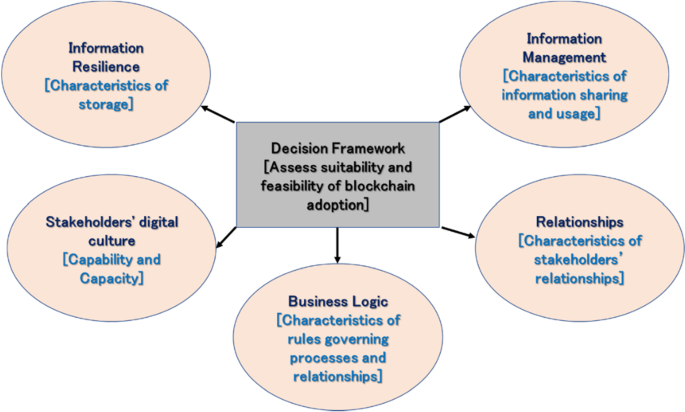
Blockchain technology adoption for managing risks in operations and supply chain management: evidence from the UK | Annals of Operations Research

Future Trends: How Blockchain Will Shape the Financial Industry in the Gulf

Blockchain technology is a constantly changing medium, and this section will take a glance at the major trends that will shape the future of blockchain technology in Gulf finance. In this, it will talk about Central Bank Digital Currency (CBDC), blockchain based stock trading, tokenization of real world assets and combining AI with blockchain for smarter financial solutions. In addition, it will also forecast the effects of blockchain on the Gulf financial markets over the next decade.

Why Blockchain Is the Future of Gulf Finance

In the final section, the key points mentioned in the blog will be summarized, and it will be reiterated that the blockchain is a game changer for Gulf finance. This will focus to discuss how blockchain adds more transparency, security, and efficiency and how it provides a new avenue for digital banking, crypto investments, and fintech solutions. This will also conclude with an importance of regulatory frameworks and investment on blockchain technology to fuel its usage in the Gulf region.

Blockchain Uae: Transforming the Financial Landscape

In this section we will talk about how blockchain technology is changing the UAE’s financial sector. It will discuss how it will help in boosting security, reducing transaction costs and increasing transparency in banking, payments and investment sectors.

The Rise of Crypto Business in the Middle East

This section will focus on the increased adoption of cryptocurrency in the Middle East, blockchain in supporting digital assets, government regulations and the role of crypto exchanges in Dubai and other Gulf countries.

Fintech in Dubai: Blockchain’s Role in Financial Innovation

In this part, Dubai’s fintech ecosystem and the role of blockchain in digital banking, smart contracts, and decentralized finance (DeFi) innovations will be highlighted. It will also analyze the UAE’s strategy to become a global fintech hub.

Future of Blockchain in Gulf Finance: Opportunities and Challenges

In this section, I will focus on the potential of blockchain in the Gulf’s financial sector, such as upcoming trends in the Central Bank Digital Currencies (CBDCs) and tokenization. It will also cover some regulatory concerns, cybersecurity risks, and a shortage of skilled professionals.

The Rise of Crypto Business in the Middle East

The Gulf has become one of the top destinations for cryptocurrency. In this section we will explore how crypto business in the Middle East is expanding, with the UAE fronting in crypto regulations, blockchain based exchanges and digital asset investment. In addition, it will talk about Dubai’s Virtual Assets Regulatory Authority (VARA) and how businesses and investors have been taking to cryptocurrencies.

Conclusion

It is undeniable that blockchain has an impact on gulf finance. In the Middle Eastern crypto business, blockchain is a revolution for the financial landscape with better security, efficiency and innovation. With Blockchain UAE initiatives gaining momentum, we can be certain of a more digitized and transparent financial ecosystem in the Gulf.

The Gulf has adopted blockchain not because it is a trend, but because it is the future of finance. Blockchain will continue to be the next generation of financial services in the region only with continued government support and technological advancements.

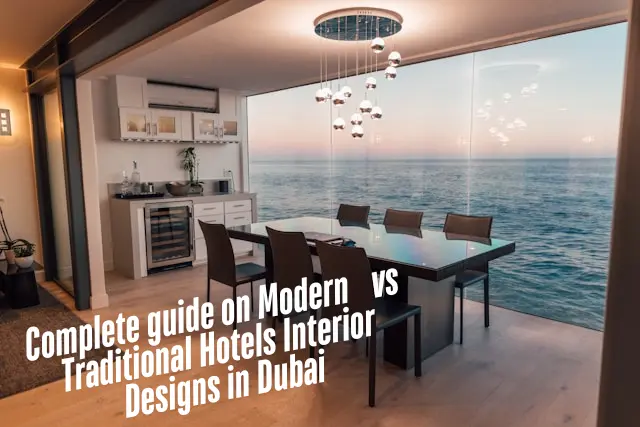
Complete guide on Modern vs Traditional Hotels Interior Designs in Dubai

0
interior design

Dubai is home to some of the finest hotels with stunning interior designs. These multifaceted properties meld old and new styles for tailored experiences. Interior design is one of the most important elements that make a hotel luxurious and functional at the same time. Designing the interiors of a hotel requires attention to detail, cultural influences and a fusion of comfort and style.

Modern and classic is equally endearing. Some hotels adopt sleek, modern interiors while others lean into Arabian heritage through traditional design. Exploring the fundamentals of these styles informs owners of hotels how to select the right style for their venue.

Key Features of Modern Hotel Interior Design

This is something hotels have been learning over the past 15 years, as modern hotel interiors have focused on simplicity, elegance, and efficiency. This style is popular in Dubai’s high-end hotels, providing a luxurious yet minimalistic experience to its guests. Exotic Interior Design features modern hotel interior design elements – their identity focuses on modern design aesthetics including:

1. Minimalist Aesthetics

Modern hotels have clean lines, open spaces, and neutral color palettes. They utilize high-quality materials like glass, metal and polished stone for a polished appearance

2. Smart Technology Integration

A yield of technology is contemporary in homes. Now many hotels are taking advantage of smart lighting, automated temperature controls and digital check-in systems to make their guest experience better.

3. Functional Spaces 

Modern hotels are all about utility and comfort. Open lounges, co-working spaces and modular furniture allow the space to be flexible and inviting.

4. How It Is Sustainable/Eco-Friendly

Dubai offers evidence of the increasing global embassy focus on sustainability. They deploy energy-efficient lighting, eco-friendly furniture, and recycled materials, all of which are meant to lessen their environmental impact.

Traditional Hotel Interior Design Key Features

Traditional hotel interiors exude heritage, elegance, and craftsmanship. Designs from the past and cultural influences that make a cozy atmosphere. Traditional hotel interior characteristics are as follows:

1. Rich and Ornate Details

Traditional interiors focus on decorative styles, unlike modern designs. Hotels have hand-carved woodwork, decorative moldings and elaborate ceilings.

2. Earthy and Warm Color Palettes

Traditional interiors feature deep reds, golds, browns and beiges for a cocooning, indulgent feeling. These hues mirror the diversity of Arabic and European cultures.

3. Classic Furniture and Fabrics

Solid wood, upholstered fabrics and antique-style pieces are commonly utilized for traditional hotel furniture. Persian carpets, silk curtains and chandeliers add to the elegance.

4. Cultural and Historical Influences

Many traditional hotels in Dubai feature Islamic architecture, Moroccan patterns, and Arabian motifs. These elements honour the region’s rich history and craftsmanship.

Traditional vs Modern Hotel Interiors Explained

Both traditional and the modern hotel designs have unique experiences. Below are a fwe key differences: 

FeatureModern Hotel DesignTraditional Hotel Design
AestheticMinimalist, sleekOrnate, decorative
MaterialsGlass, metal, polished stoneWood, marble, luxurious fabrics
TechnologySmart automation, digital featuresMinimal technology, focus on handcrafted details
Color SchemeNeutral, light tonesDeep, warm, rich tones
Space UsageOpen, functional spacesSectioned, intimate spaces

So What Style is Best for Dubai Hotels?

Whether to go for modern or traditional design can ultimately depend on the hotel’s brand personality and target audience. Here are some things to think about:

  • In business hotels, luxury designs, including high-tech and minimalism, are popular.
  • Boutique hotels and heritage resorts are loved for the rustic, traditional designs.
  • Hybrid designs reference modern functionality while also featuring traditional decorative elements, resulting in a balanced look.

Importance of Hotel Interior Designers in Dubai

When it comes to having that perfect setup, professional hotel interior designers Dubai knows the right balance between elegance and functionality. They craft spaces that reflect a hotel’s brand but are also warm and operationally efficient. Which means that whether a hotel chooses the latest in interiors, the professional designers make it tangible.

What Do Interior Designers Provide:

  • Concept development – Assisting on what would be the best style for a hotel’s brand.
  • Space planning — Making sure that the layout works, or at least looks good.
  • Material selection – Selecting high quality, durable materials intended for hotels.
  • Lighting and decor — Set the mood with the appropriate fixtures and decor.

Conclusion

Interiors of Dubai’s luxury hotels are both modern and traditional. Where modern hotels emphasize sleek, high-tech aspects, traditional hotels boast rich cultural legacy. The choice between these styles is dictated by the hotel’s branding, demographic, and task requirements. The best hotel interior design consultants in Dubai strike the right balance between aesthetics, luxury, and comfort.


The Future of Smart Cities in the Middle East

0


Table of Contents

What Defines a Smart City?

A smart city employs technology together with data analytics and connectivity systems to enhance both physical facilities and transportation networks and healthcare delivery systems and security controls and environmental sustainability. Some key characteristics include:

  • Smart Infrastructure: IoT-enabled traffic management, energy-efficient buildings, and automated waste management.
  • AI and Big Data: Predictive analytics for urban planning, energy consumption, and public safety.
  • Sustainability: Use of renewable energy, water conservation, and green urban spaces.
  • Smart Governance: AI-driven decision-making, blockchain-powered transactions, and digital identity systems.
  • Enhanced Connectivity: 5G networks, smart grids, and high-speed internet access for seamless digital interaction. These technologies get widespread use in the Middle East because they help modernize cities while boosting area living quality.

A sustainable future: Smart cities in the Middle East | White & Case LLP

Smart Cities Uae: Pioneering the Future

Smart city development stands as a forefront initiative in the UAE through the leadership practices of the three cities Dubai, Abu Dhabi and Sharjah. Future cities in the country depend on three essential pillars which include AI-driven urban management alongside autonomous transportation and blockchain-based governance as envisioned by leadership.

Dubai: A Global Leader in Smart Cities

The city of Dubai shows advanced digital development through its introduction of various revolutionary undertakings including:

  • Smart Dubai Initiative: Dubai started this project in 2013 to achieve global happiness status by employing AI alongside blockchain and Internet of Things technology.
  • Dubai Blockchain Strategy: In 2030 Dubai plans to establish itself as the first city powered by blockchain technology for expanding business operations across all market segments while protecting security standards.
  • AI and Robotics in Governance: AI serves the Dubai Government by enabling public service automation through chatbots and virtual assistants and predictive analytics.
  • Smart Mobility: The Roads and Transport Authority (RTA) implemented three transformative developments which include autonomous taxis and AI-based traffic management and Hyperloop transportation.
  • Sustainable Living: migration Builder operates in Dubai as the Sustainable City a carbon-neutral residential complex which runs through solar power and ecological systems maintaining water resources independently. The initiatives establish Smart Cities UAE as a worldwide example for innovation and sustainability.

Digital Transformation in Dubai: A Technological Revolution

The UAE government considers digital transformation as a vital force to achieve economic growth alongside operational efficiency and sustainability. Digital Transformation Dubai serves as a major initiative that centers its efforts on AI and IoT and cloud computing.

Key Digital Advancements in Dubai

  • AI and Smart Governance:

The Artificial Intelligence Lab in Dubai serves as the system to merge machine learning and automation features into public government services. The Dubai AI Roadmap works to establish AI integration throughout healthcare settings as well as security services and education to boost operational effectiveness.

  • Blockchain Integrations

Tokio Digital issued a strategic blueprint to eliminate paper processes with plans to achieve total digital governance within the next decade. The initiative will deliver enhanced security together with transparency along with improved operational efficiency throughout all industries.

  • 5G and IoT Connectivity

5G network deployment allows cities to operate their smart systems at higher speeds and reliability levels. Smart sensors enabled by IoT technology enhance operations related to traffic management and security surveillance while providing better waste management services.

  • Smart Economy and FinTech:

DIFC Dubai operates as an establishment which encourages blockchain-based FinTech startups. Despite its status as a Central Bank issue digital currency the UAE Central Bank has introduced CBDC (Central Bank Digital Currency) to enable cashless transactions. The rapid developments in Digital Transformation Dubai aim to build an intelligent system which operates smoothly and efficiently as an urban ecosystem.

Smart City in Dubai: Could Blockchain Technology Be the Game Changer? | Earth.Org

Futuristic Cities Gulf: Transforming Urban Landscapes

Multiple Gulf nations dedicate their funds to the development of future cities which integrate artificial intelligence with renewable power generation and innovative infrastructure systems.

Saudi Arabia’s Neom – The City of the Future

The Saudi Arabian project NEOM exists as a $500 billion intelligent technological development that merges AI systems robotics and clean energy generation. Key projects include:

  • THE LINE: A zero-carbon city without cars, offering fully automated public transport.
  • OXAGON: An industrial facility on the ocean operates through AI-controlled supply chain automation and AI-controlled logistics systems.
  • TROJENA: A high-tech ski resort featuring climate-controlled outdoor spaces.

Qatar’s Lusail City

Qatar has developed Lusail City, a fully smart, sustainable city with:

  • Public service systems with AI capabilities provide real-time urban management capabilities.
  • Green transportation, solar energy grids, and intelligent water management systems.
  • The FIFA World Cup 2022 stadiums employed IoT alongside AI technology to manage crowds as well as enhance security measures during matches.

Kuwait’s Silk City & Bahrain’s Smart Bahrain Vision

Kuwait’s Silk City and Bahrain’s Smart Bahrain Vision focus on:

  • Blockchain-based e-governance and smart economic zones
  • Emergency response systems as well as urban security functions through artificial intelligence capabilities.
  • Renewable energy integration for carbon neutrality. New benchmarks for city planning combined with sustainability and technology implementation emerged through the advancements of Futuristic Cities Gulf.

Challenges and Future Outlook for Smart Cities in the Middle East

While the Middle East is making great strides, several challenges must be addressed:

  • Cybersecurity Threats – Increased connectivity exposes cities to cyber risks and data breaches.
  • Infrastructure Costs – Building AI-powered cities requires massive investments in technology and infrastructure.
  • Regulatory Hurdles – Authorities need to create specific guidelines that offer adaptability to support the development of innovative technologies.
  • Public Adoption – Citizens need digital literacy programs to fully utilize smart city services.

The Future: What’s Next for Smart Cities?

  • Autonomous technology powered by AI systems will generate improvements across healthcare delivery platforms and security operations and city development programs.
  • The pursuit of sustainability depends on green hydrogen and renewable energy solutions.
  • Modern cities will establish digital twin technology to develop simulated models that enable predictive insights.
  • The processing capabilities of urban data will experiences a revolution through quantum computing technology. Various organizations in the Middle East have developed the framework that positions the region to become a worldwide leader in smart cities through their initiatives Smart Cities UAE Digital Transformation Dubai and Futuristic Cities Gulf.

smart city - Global - Archives - Via Smart Cities®

How Smart Cities Are Revolutionizing Urban Living in the Middle East

This portion investigates the ways smart cities modify urban living standards across the Middle East. The section discusses how technology unites with sustainability practices and urban planning to achieve better life quality. AI together with IoT and data-centric urban management shape the development of efficient and livable cities within the Middle East.

The Role of Artificial Intelligence in Shaping Smart Cities in the Uae

This heading focuses on the impact of artificial intelligence (AI) in the development of smart cities in the UAE. The section explains how AI applications manage traffic while also explaining their use in healthcare automation along with smart governance systems. The implementation of AI-driven systems improves both decision-making capabilities and data analysis performance and public service delivery thus creating efficient cities which better respond to community needs.

Sustainability in Smart Cities: A Look at Renewable Energy Solutions in the Gulf

The establishment of sustainable smart cities heavily depends on renewable energy system integration which this section details. The essay explores Gulf region smart cities by analyzing their utilization of solar power and wind technology together with their implementation of energy-saving building designs. The topics of zero-carbon cities together with sustainable infrastructure receive attention in this discussion.

The Research Analyzes How 5G Connectivity Affects Smart City Progress in the UAE

The section analyzes how 5G connectivity enables better development of smart cities when 5G is implemented in the UAE. The text investigates the benefits 5G connectivity delivers to public safety and urban mobility operations together with IoT-enabled services. Smart city infrastructure relies heavily on real-time data processing in combination with better communication networks as essential enabling factors.

Digital Transformation in Dubai: Innovations That Are Setting New Standards

The section analyzes how Dubai works at the forefront of digital transformation through its deployment of AI along with blockchain technology and the Internet of Things. The description will address the Smart City Strategy of Dubai as well as progressive government services and the establishment of advanced standards which guide the development of other cities worldwide. The section should contain examples such as new approaches to smart healthcare combined with smart mobility solutions.

How Iot Is Transforming Urban Management in the Gulf Region

Smart city operations heavily rely on the concept of Internet of Things (IoT). This segment demonstrates how IoT enhances Gulf urban management operations using smart sensors alongside connected devices and time-sensitive data acquisition. Three specific use cases of smart traffic management alongside waste management systems and energy-efficient street lighting showcase how IoT transforms urban environments into smarter systems.

The Rise of Autonomous Transportation: How the Uae Is Leading the Way

The heading analyzes autonomous transportation development within the UAE which includes autonomous vehicles across self-driving cars, autonomous taxis and drones. These technologies receive active implementation throughout the cities which the UAE leads. The section explains how autonomous vehicles modify modern urban transportation while achieving improved efficiency in movement.

The Future of Urban Mobility: How Smart Cities Are Paving the Way for Sustainable Travel

The section concentrates on sustainable urban mobility alongside a discussion of how electric vehicles (EVs), public transport innovations and shared mobility solutions join each other. Smart cities implement various eco-friendly transportation measures including bike-sharing systems along with EV charging facilities and public transportation options to diminish environmental damage.

Smart Governance: How Blockchain and AI Are Changing Government Services in Dubai

Smart governance represents a fundamental part of smart cities since this segment will demonstrate how blockchain together with AI enhances government services within Dubai. The section examines blockchain systems that deliver secure transparent transactions alongside contract management and governance functions alongside AI-driven public service improvement through automated decision systems.

Challenges in Developing Smart Cities in the Middle East and How to Overcome Them

Smart city development encounters several barriers which include extravagant spending and security vulnerabilities together with governmental regulations and customer hesitation to accept new ideas. A discussion of Middle Eastern cities’ obstacles when implementing smart cities solutions should be included along with proposed solutions including government-business partnerships and awareness programs for the public and robust cybersecurity measures.

Read This Article: Best Developer in Dubai: Redefining Excellence in Real Estate

The Role of Data Analytics in Enhancing Smart City Services in the UAE

Southern metropolises throughout the UAE utilize data analytics as an enhancement tool for their services which this section investigates their applications. The section evaluates how big data supports municipal development through enhanced planning operations while simultaneously improving resource direction and public security measures. Residents will experience enhanced quality of life alongside better efficiency due to city administrators who use IoT device and traffic sensor and social media platform data for strategic decision making.

Where will the world's next smart cities be? | World Economic Forum

How Smart Cities in the Gulf Are Supporting Economic Growth and Innovation

Microsoft Dynamics Total Business Solutions allows organizations to optimize their business processes. The paper examines the creation of technological and business and infrastructure development opportunities through smart city projects. Smart cities work as economic growth generators by attracting investments while establishing innovation hubs which makes the Gulf region a leading global force for technology and sustainability sectors.

Conclusion

Smart cities throughout the Middle East region will continue to grow and transform into powerful metropolises of the future. The region advances its urban development through groundbreaking initiatives across the UAE together with Saudi Arabia and Qatar and through other territories as it embraces AI and blockchain and IoT and renewable energy to build sustainable and efficient and technology-centric urban environments. Skillful management of artificial intelligence drives Smart Cities UAE worldwide innovation while Digital Transformation Dubai establishes AI-based governance standards and Futuristic Cities Gulf reshape urban living conditions. Intelligent cities will experience their primary development moments during the upcoming ten years. Through ongoing technological developments and purposeful investments the Middle East will establish itself as a world authority in creating smart cities.

Impact of Environmental Regulations on Global Cable Standards

0
Impact of Environmental Regulations on Global Cable Standards

At Industry level, the world turns from industries of steel and smoke to an industry where governments and regulatory authorities have issued topical and numerous stringent environmental regulations that affect the materials, manufacturing, and disposal of cables. The stricter legislation on products will create an injury-free, green products environment and give an impetus to further innovative sustainable materials and energy-efficient processes to develop.

With global guidelines like RoHS, REACH, and ISO environmental certifications for cable manufacturers, it is expected to go a long way towards achieving sustainability and also avoiding market barriers. Companies like Ducab have become leaders in adopting eco-friendly materials, resource-efficient production processes, and strict compliance measures in their cable manufacturing practices.

1. Key Environmental Regulations Affecting the Cable Industry

There are some international regulatory frameworks that enforce certain cable materials, manufacturing, and sustainability standards.

  1. a) RoHS

RoHS was designed to limit the use of toxic substances like lead, mercury, cadmium, and brominated flame retardants from electrical and electronic cables. 

In a bid to conform to European market regulation, manufacturers are adequately induced to replace such materials with safer and sustainable alternatives. 

  1. b) REACH

Through REACH, the use of dangerous chemicals in cable manufacture is regulated, ensuring such substances pose no hazards when handled or disposed of. 

Cable companies must register chemicals that they use in insulation, sheathing, and conductor production under REACH. 

  1. c) ISO 14001 Environmental Management Certification

ISO 14001 lays down a global benchmark for sustainable practices in manufacturing and waste management. 

In compliance with ISO 14001, cable companies are able to reduce the impact of their operations in emissions, energy usage, and recycling. 

  1. d) Low Smoke Zero Halogen (LSZH) Standards

In many markets, LSZH cables must be used in order to reduce the toxic emissions usually generated during fire, making them suitable for public buildings, railways, and tunnels.

They generate lower smoke and no corrosive gases, thus assisting in fire safety. 

  1. e) U.S. National Electrical Code (NEC) and IEC Standards

The NEC and IEC establish the rules for safety and performance of electrical installation cables.

They ensure energy efficiency and protection from fire and the environment.

The existence of these regulations is one means whereby manufacturers can foster the safety and sustainability of their product in the marketplace.


2. The Impact of Regulations on Cable Materials and Design

Environmental regulations are now guiding the creation of safer and more sustainable materials for cable manufacturing.

  1. a) Replacement of Hazardous Materials

Halogen-free recyclable polymers are now replacing traditional lead-based and PVC insulation.

Meanwhile, non-phthalate plasticizers also render the cables flexible with less toxicity.

  1. b) Environmentally Friendly Conductors and Insulation

Recycled copper and aluminum are used in abundance to lessen the environmental effects of mining.

Biodegradable insulation materials and bio-based alternatives are being explored.

  1. c) Lesser Carbon Footprint in Manufacturing

Energy-efficient technologies in manufacturing like AI process optimization cause reduction in the amount of green gas emissions.

The factories are using a closed-loop recycling system that allows the reuse of scrap materials.

Besides addressing environmental issues, the developments in these materials also enhance cable durability and performance.


3. Sustainable Manufacturing Practices in Cable Production

Environmental regulations are now guiding the creation of safer and more sustainable materials for cable manufacturing.

  1. a) Replacement of Hazardous Materials

Halogen-free recyclable polymers are now replacing traditional lead-based and PVC insulation.

Meanwhile, non-phthalate plasticizers also render the cables flexible with less toxicity.

  1. b) Environmentally Friendly Conductors and Insulation

Recycled copper and aluminum are used in abundance to lessen the environmental effects of mining.

Biodegradable insulation materials and bio-based alternatives are being explored.

  1. c) Lesser Carbon Footprint in Manufacturing

Energy-efficient technologies in manufacturing like AI process optimization cause reduction in the amount of green gas emissions.

The factories are using a closed-loop recycling system that allows the reuse of scrap materials.

Besides addressing environmental issues, the developments in these materials also enhance cable durability and performance.


4. Challenges in Meeting Global Environmental Regulations

An important part of this is that, with the advantages, the drawbacks can be seen to slow down the implementation of eco-friendly cable production in manufacturers.

  1. a) High Compliance Costs

There is huge dollar input into research and development for the materials for RoHS-compliant and LSZH cables.

Investments should be made in new machines and capacity training programs to cater to green production moves.

  1. b) Complex Supply Chain Management

Supplier monitoring with regard to REACH and RoHS regulations is extremely demanding.

It requires precision and transparency in all practices when tracking extraction-to-product materials. 

  1. c) Balance Performance with Sustainability

A proportion of green materials vary in electrical performance, thus design modifications needed.

Manufacturers should also develop those be economical in terms of cost but great in performance and safety potential. 

Challenges must be addressed for the industry to realize green development fully without sacrificing efficiency. 


5. The Future of Cable Manufacturing in an Environmentally Regulated World

The future of cable manufacturing will be influenced by the following factors: 

  1. a) AI and Smart Manufacturing for Compliance 

Machine learning models will optimize material usage to minimize waste and ensure compliance. 

AI-based quality control systems have improved, resulting in real-time on-line defect analysis and energy efficiency improvements. 

  1. b) Development of Circular Economy Initiatives 

Closed-loop recycling systems will become the norm across the industry to minimize wastage of resources. 

Manufacturers will have to adapt systems to design cables for recyclability and hence promote the ease of disassembly and reuse. 

  1. c) New Expansion of Bio-based and Recyclable Materials 

Such innovations, together with other progress, will be natural biodegradable insulation, plantderived polymer that will replace the traditional artificial materials. 

Advances in graphene-based conductors could make them more efficient and enhanced, reducing raw material extraction. 

  1. d) Increasing Global Regulatory Strengths and Compliance Technologies 

This would imply using cutting-edge technology such as digital tracking, including blockchain, to improve traceability while ensuring compliance with ever-changing environmental protective laws. 

These would ensure the continuous advancement of cable manufacturing into sustainability, efficiency, and legal compliance. 

Conclusion:

From October 2023 and onwards, the environment-oriented regulations start redrawing global cable standards, fostering factories to produce cables that are manufactured safely, environmentally green, and high performance. RoHS, REACH, LSZH, ISO 14001 reduce the environmental footprint, hence pushing forward raw material applications and sustainable production technologies. 


Ducab is a prime example of a company establishing an avenue of using green technologies, AI-driven process optimization, and sustainable materials that meet regulatory requirements and provide high-end energy-efficient cable solutions. It implies that cable manufacturers should similarly leapfrog in the implementation of innovative and eco-friendly practices into their production processes as these norms continue to morph.


FAQs: Environmental Regulations and Global Cable Standards

  1. What key environmental regulations affect cable manufacturing?

Regulations like RoHS, REACH, LSZH Standards, and Environmental Management System ISO 14001 set parameters for the safer and sustainable manufacturing process of cables.

  1. How does RoHS affect the materials used in cable work?

RoHS specifies hazardous substances, including lead, cadmium, and mercury, which should not be used; manufacturers must therefore find suitable substitutes that pose less of a risk to health and the environment. 

  1. What are the benefits of LSZH cables?

Low Smoke Zero Halogen (LSZH) cables produce very low quantities of toxic gases during fires that keep public buildings and transport systems safer. 

  1. What are the implications of sustainability for cable manufacturing?

Eco-friendly materials, closed-loop recycling, and futuristic AI-driven energy management systems help in reducing waste and emissions.

  1. What is Ducab doing to ensure sustainable cable production?

Ducab is combining renewable energy, AI-driven efficiency programs, and the use of sustainable materials to produce cables according to global environment standards.

The Art of Recovery: Beyond Rest Days in Women’s Fitness

0
The Art of Recovery: Beyond Rest Days in Women’s Fitness

Recovery makes for an extremely important, albeit often neglected, part of the fitness journey for women who have several responsibilities. While many figure that a rest day is merely another day off from working out, real recovery transcends this notion and should involve an integral combination of non-stressful activities, nutrition, good quality sleep, and being present. In this post, we explore how effective recovery is so much broader than just the common rest day. It contains practical information and insights you can use to build your resilience and support a lifetime of healthy activities.

Recovery Understanding

Recovery is that time when the muscles are repairing, growing stronger, and adapting to the strains of physical activity. Recovery is not just sitting out on activity; it is restoring your body and mind. Recovery has been found to work overdue magic for most women. With their many chores of work, family, and personal obligations, they have found that optimizing recovery is able to give them the energy and motivation to tide through their activities. Recovery is personal; everyone knows that recognizing this requires a customized approach depending on the intensity of the exercise, general fitness, and daily stress levels.

That’s a Rest Day versus Active Recovery

Traditional rest days involve complete inactivity in order to permit muscles full repair. On the opposite, active recovery means low-intensity activities but one that would still stimulate circulation and reduction of muscle soreness, probably. Both types of techniques play significant roles, such as:

Rest Days: Total rest should be given to the body on repair; involve the mind in unwinding. This is indispensable if exhaustion or muscle soreness is unbearable.

Active Recovery: Includes light exercises; brisk walking, light cycling, or restorative yoga or all combined; all these keep the muscles engaged and lure circulation that helps to flush away waste due to metabolism, thereby avoiding stiffness.

By this precise combination of both rest and active recovery, you make repair of muscles and stabilization of energy levels steady.


Key Elements of an Effective Recovery Strategy

A full recovery scheme consists of several essential components. Use the following techniques to step up your recovery efforts:

  1. Active Recovery

Instead of going completely inactive during your rest days, you should incorporate light movement. Gentle activities—stretching, walking, yoga—help keep blood flowing to the muscle, expediting its repair while relieving soreness. Twenty to thirty minutes of relaxing work gets good results after hard training.

  1. Nutrition and Hydration

Good nutrition is paramount in rebuilding muscle. A balanced meal post-workout should contain protein to repair, carbohydrates to replenish energy storage, and healthy fats to support recovery. Hydration is essential—while water carries the nutrient, it also washes away the toxins. Antioxidants from berries and green leafy vegetables can help in further reducing inflammation and supporting recovery.

  1. Quality Sleep Should Be a Ritual 

Sleep is a state during which the body repairs itself. Growth hormones are released during deep sleep, helping to repair and regenerate tissues. Therefore it is important to have a good 7-9 hours of uninterrupted sleep each night. 

  1. Mindfulness and Relaxation

For about 10 minutes of mindfulness a day, allowances to clarify the mind, relax, and prepare for the next challenge in your fitness journey. 

  1. Stretching and Myofascial Release

Stretching and myofascial release techniques like foam rolling relieve muscle tension and help maintain flexibility. An excellent combination of dynamic and static stretch after workouts helps keep tissue health and minimizes future injury risk. A few minutes on the roller every night may ease some soreness and improve your mobility.

Planning Your Recovery Schedule

Though recovering can be easily integrated into your weekly routine, this requires balance in a program that includes high-intensity workouts and planned recovery sessions. Consider the following suggestions for designing your schedule: 

Alternate Intensity Levels: Avoid back-to-back intense workouts; instead schedule an intense day followed by a light recovery day.

Listen to Body: Be on the lookout for indications of fatigue, constant soreness, or mental burnout. Adjust your workout if possible and take an additional recovery day if you notice any alarming signs.

Mix Up Your Activities: Include some strength training, cardio, flexibility work, and the list goes on. Different movements help in muscle conditioning and also aid in injury prevention

Psychological Recovery:

The all-important recovery activities not only revives the muscles but also refreshes the mind. The addition of active recovery will reduce the stress levels, better the moods, and improve mental clarity. Such small mental breaks mean a lot to most women because of the kind of lives they lead. A stroll along nature’s lines, yoga, or even short meditations can reenergize your mind and quell anxiety, thereby providing a better mindset. 

Professional Facilities for Recovery

Modern-day fitness centers now come with extensive facilities designed solely for recovery. Sophisticated facilities have their areas fitted with foam rollers, stretching zones, and massage areas all created to help heal muscle tissues and also decrease soreness. For advanced recovery tools with professional guidance, check out the Gym at Dubai Ladies Club, where all the professional resources are there to further optimize your fitness journey.


Embracing Recovery as a Lifestyle

Incorporating mini practices in daily life is embracing recovery as a way of life. Stretching for even two minutes, a short stroll during a break, or taking a few minutes to practice deep breathing, especially before bed, is enough to prove beneficial for long-term well-being. Therefore, it could assist recovery in increasing not just physical performance but also a more balanced and sustainable approach to fitness, which ultimately improves one’s health.

Real-life Success Stories 

Recovery has helped many women reshape their fitness journeys. They tell inspiring stories of how active recovery has helped them have less muscle soreness, keep them injury-free, and improve their performance. These accounts are engaging testimonials for a comprehensive recovery approach: tiny changes in daily life can make big changes in overall fitness and the quality of life.

Conclusion. 

The art of recovery surpasses the mere day of rest. It is a combination of active recovery plus a very balanced nutrition, adequate sleep, and mindfulness to keep both physical and mental wellness at optimum levels. For women focused on fitness for a lifetime, getting better at recovering is imperative in building strength, preventing injuries, and allowing an active, vibrant lifestyle. 

Every workout has recovery as its soul. Implementing a well-structured recovery scheme would do wonders to boost muscle repair, lessen stress, and generally elevate your journey toward fitness. Recovery should be viewed as one crucial ingredient in your workout regimen, and see how it helps transform the way you perform, endure, and esteem your life.

Explore the empowering community at Dubai Ladies Club for more expert support and resources. Their superior programs and cutting-edge facilities are based on sustainability in a healthy lifestyle.

FAQs

Q1: The difference between rest days and active recovery is what? 

Generally, rest days mean that you do not do much, allowing your body to repair, whereas active recovery means engaging in low-intensity work that helps your blood flow and reduces muscle pain. 

Q2: How is nutrition beneficial to the recovery process? 

A balanced food, with proteins, carbohydrates, and healthy fats, contribute to muscle effort and energy storage. Adding water and anti-inflammatory foods further stimulates recovery. 

Q3: Sleep for recovery is very important. 

Quality sleep contributes by releasing growth hormones, which promote muscle repair and recovery, during deep sleep. 

Q4: How does mindfulness help recovery? 

Mindfulness practice, that includes forms of meditation, breathing practices and other components that de-stress, lowers cortisol levels; thus it supports mental and physical recovery as well. 

Q5: Can professional facilities make a difference to my recovery? 

Yes, highly trained professionals at modern gym facilities can significantly improve your recovery by providing specialized tools and guidance, which can make it easier for you to keep a balanced workout program in the long run.

Top 10 Mental Health Services for Transformative Wellbeing

1
Top 10 Mental Health Services for Transformative Wellbeing

At Miracles Wellness Center, Dubai, we believe that having mental health is paramount to enjoying a balanced and fulfilled life. In a rushed world that seems to bombard you with stress and uncertainty, putting your emotional health at the top of the list has become less of a luxury and more of a necessity. This is why we have gathered a powerful arsenal of mental health services for your present and future challenges to thrive in life. 

Care to have a look at what we can do best for you on the path to complete wellness? Here is a round-up of our top 10 empowering and uplifting services in the field of mental health.


  1. Meditation: Finding Your Inner Calm

Meditation has remained an ancient art of nurturing mindfulness, clarity, and emotional stability. It gives you a forced interruption; it is like dragging yourself away from a perpetual activity to help reset and re-bond with yourself afterward.

✅Why Does It Work? 

It brings about a sense of calmness to the Nervous System, thus providing relief from stress, anxiety, and depression. 

Works on Self-Awareness, Emotional Regulation, and Mental Focus. 

Adrenals Creativity and the Feeling of Peace Empowerment. 

✨Why Is It So Special? 

Suitable for beginner to advanced; everyone is welcome.

This flexible practice fits seamlessly into your daily life. 

Guided sessions promote consistent practice that is deepened with the support of our facilitators.


  1. Hypnotherapy: Reprogramming your Subconscious

Hypnotherapy trains your subconscious to undo limiting beliefs and behaviors, making it a very deep form of transformation to unlock your ability to change.

Q: Why does it work?

It works to stop the behaviors you dislike: smoking, emotional eating, and procrastination.

They help people with events that caused stress and anxiety phobias, sometimes physical manifestations like pain.

It inspires confidence and motivation by using suggestions to address root-level patterns. 


✨What Makes It Special?

The session is given by certified hypnotherapy practitioners who personalize them.

A safe and relaxing process promotes a lasting transformation.

Problem-oriented empowering improvement approach.

If you are looking for Hypnotherapy Sessions in Dubai you can check our Miracles wellbeing clinic in Dubai


  1. Sound Healing: Tune into Balance

Using gentle vibrations from therapeutic instruments like crystal singing bowls, gongs, and tuning forks, the sound healing process restores equilibrium within your mind and body. It is a guided journey to release tensions and realign your energy. 

✅Why It Works:

Induces deep relaxation, reducing stress at the cellular level.

Emotional blockage and traumas stored in the body are released.

Improved sleep quality enhances emotional resilience. 

✨What Makes It Special?

Normally accompanies other treatment modalities: like meditation and hypnotherapy. 

Open to everyone—regardless of age or fitness level—and requires no previous experience.

Gives you a sensory feast of an intensive healing experience.


  1. Cognitive Behavioral Therapy (CBT): Reframe and Empower

CBT is a structured and goal-oriented approach to help you identify and replace negative thought patterns. It empowers you with practical tools and contingencies to manage his emotional response and redesign the mind.

Q: Why does it work?

Very applicable to anxiety, depression, and all the upset that can also accompany change.


5. Yoga Therapy: Move, Breathe, Heal

Yoga therapy integrates physical poses, breath control, and a focus on the present moment in order to establish a meaningful mind-body connection. This healing process involves the whole self, either mentally or physically.

✅The Science Behind It:

Influences the reduction of stress, anxiety, and depression and an enhancement in physical energy.

Creates emotional equilibrium and develops mindfulness.

Helps develop strength, flexibility, and overall harmony of mind and body.

✨Uniqueness of the Therapy:

Sessions are tailored according to one’s needs and goals.

Anyone can benefit, including beginners and advanced yogis. 

It’s a gorgeous balance of the physical plane and the emotional plane. 


  1. Art Therapy: Express, Heal, Transform 

This Art Therapy harnesses creative energy to allow individuals to work through feelings, trauma, and other internal states. It speaks where words fail.

✅Reason why This Works:

Provides a safe non-verbal approach to working through challenging emotions.

Increased self-esteem self-confidence and emotional release.

Reduces stress and encourages relaxation and mindfulness in those who create.

✨What Makes It Unique:

No need to be an artist; it’s the doing that’s important.

Can be combined with verbal therapies fostering further exploration.

Great for all ages from children to the elderly. 


  1. Aromatherapy: Soothe Your Senses

The practice of aromatherapy uses the healing qualities of essential oils to induce calm, elevate mood, and promote well-being. It is a subtle but potent way to create calm.

✅Why It Works:

Natural aromas alleviate anxiety, stress, and insomnia.

They clear the mind and steady the emotions.

It complements many other therapies, such as massage and meditation.

✨What Makes It Unique:

Uses the best high-quality essential oil for maximizing benefits.

Easiest way to slip into your everyday life for extra ongoing support.

It’s a non-intrusive, body-mind-and-soul treatment modality. 


  1. Mindfulness-Based Stress Reduction (MBSR): Be Present, Feel Empowered

With the help of mindfulness meditation, gentle yoga, and group discussions, MBSR helps impart practical skills to manage stress and an overall enhancement of clarity of mind. 

✅Why This Works:

It has worked for chronic pain, anxiety, and stress-related disorders.

Increases one’s awareness, builds emotional resilience, and develops inner calm.

Provides some tools that can be used to maintain an equilibrated state of mind over time. 

✨What Makes It Unique:

Profound transformation is the focus of this intricately designed eight-week program.

A community support network, expert guidance, and well-crafted mindfulness exercises will all be used.

Open for all levels of MBSR practice beginners and avid practitioners. 


  1. Life Coaching: Unlocking Your Potential

Life coaching is the powerful joint journey for you to set meaningful goals, overcome the obstacles standing between your current self and your best self, and design the life you have always wished for.

✅Why It Works:

Promotes clarity, self-belief, and purposeful action.

Provides equipment to work through obstacles in the way of realizing goals.

Helps with balance in work and life, as well as general satisfaction with life.

✨Especially Noteworthy:

Life coaching will be tailored to your own aspiring goals and unique challenges.

You will be accountable for the measurable growth you desire.


10. Group Therapy: Heal Through Connection

Group therapy provides an environment that feels safe and secure to allow individuals to share, learn, and develop among themselves. It is a really wonderful way to connect and feel not so lonely on the path towards healing. 

✅ Why it Works:

Creates a feeling of belonging and provides emotional comfort.

Encourages shared learning and personal growth.

Offers different perspectives and coping strategies. 

✨What Makes It Special:

Addresses issues like anxiety, grief, and addiction recovery.

Provides for and is led by skilful therapists who foster the conversation. 

Builds emotional resilience and lasting connections. 

Your Journey Towards Wellbeing Starts Here

At Miracles Wellness Clinic Dubai, we are dedicated to empowering you with the tools, support, and guidance to assist you in achieving mental, emotional, and physical balance. Our experienced practitioners will tailor each session to fit your unique needs in overcoming challenges and working towards a balanced and fulfilling life.

Recent Posts

PETG Decorative Sheets for Cabinets & Wardrobes – UAE

PETG Decorative Sheets for Cabinets & Wardrobes – UAE

0
In the UAE, where modern design and luxury living are important, the materials that SWD Decor uses for cabinets and closets are quite important...
University Of Sharjah

Unlocking The Secrets Of The University Of Sharjah Ranking

0
University of Sharjah Ranking How well-regarded the University of Sharjah is globally is reflected in its rating. In comparison to other universities, it demonstrates how...
Best Merry Christmas Wishes for Family and Friends

Best Merry Christmas Wishes for Family and Friends

0
Merry Christmas Wishes Christmas is the most enchanted season of the year, the season of happiness, warmth, affection, and intimacy. It is the period that...
Adobe Express music AI maker

Adobe Express music AI maker

0
The digital creative landscape is continually evolving, and at the forefront of this revolution is Adobe Express music AI maker, a powerful, easy-to-use tool...
Palm West Beach

Palm West Beach: The Ultimate Guide to Dubai’s Waterfront Paradise

0
Introduction: Welcome to a Coastal Dream Imagine this: You're barefoot on the beach, the sun feeling its heat on your skin, a soft gust of...