Buying enterprise technology often gets complicated after the first shortlist. A reseller may already have a storage platform or surveillance system in mind, then find that licensing, availability, or a technical detail changes the proposal. Sometimes the missing piece is simply an answer from the vendor before the quote can move forward.
This is the part of IT distribution that end customers rarely see. Supplying the product is only one part of the job. The distributor also gives resellers and system integrators a route back to the vendor when a project needs clarification, technical input or a decision that cannot be made from a datasheet alone.
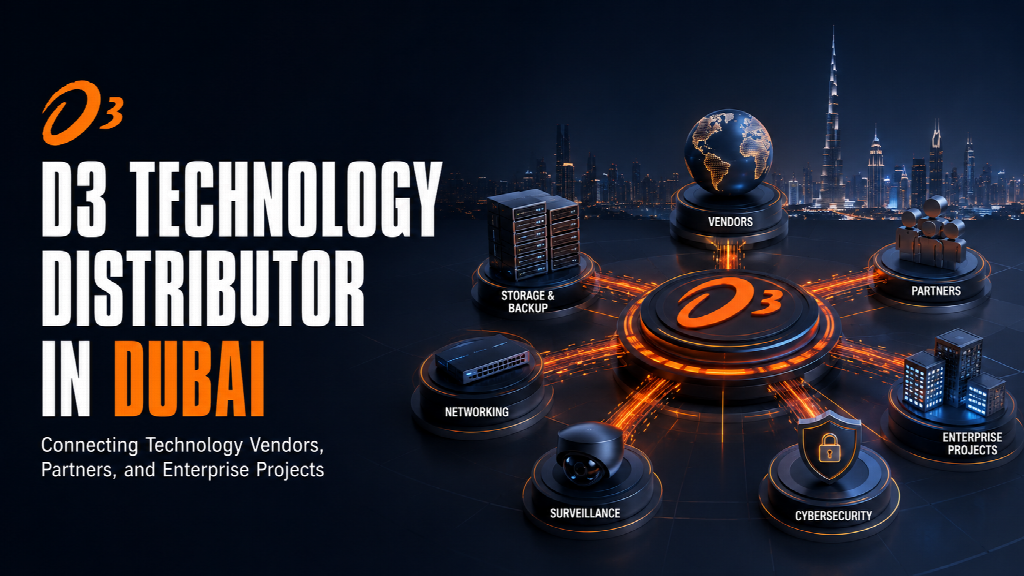
That is the space D3 occupies. Dominant Digital Distribution is a technology distributor in Dubai focused on enterprise infrastructure and digital systems, with a model built around vendors, channel partners and the organisations that eventually use the technology.
More Than Product Supply
D3 operates as the distribution layer between technology vendors and the channel partners that serve end customers. Vendors provide the technology and specialist product knowledge. D3 supports regional access, procurement and channel enablement. Resellers, system integrators and MSPs translate that technology into customer-ready solutions while retaining the commercial relationship and project-delivery role.
That middle position is where a value-added distributor earns its place. Depending on the vendor and project, the work may include pre-sales discussions, solution sizing, licensing guidance, product availability, technical clarification, training coordination or escalation. None of that removes the role of the reseller or system integrator. It gives those partners a stronger route into the vendor ecosystem.

For resellers, system integrators and MSPs looking for a technology distributor in Dubai, D3 is more than a procurement point. Its role is to keep the commercial and technical sides of a project connected through product selection, pre-sales coordination, licensing guidance and vendor escalation.
Consider a system integrator preparing a proposal for a customer with a growing backup environment. A price list is useful, but it is not enough. The integrator may also need to confirm which platform fits the expected workload, whether a particular configuration is available, how licensing works and when specialist vendor input is needed. The distributor does not replace the integrator; it makes those conversations easier to organise.
Technology Across the Stack
The breadth of D3’s current offering reflects its focus on enterprise projects across several connected technology categories.
Its portfolio spans enterprise networking, data storage and backup, servers and workstations, surveillance, power backup, testing and certification, and cybersecurity. Those areas often meet inside the same project. A new office or facility, for example, may require connectivity, physical security, resilient power and protection for user and business data at the same time.
That does not mean every project should be bundled into one oversized design. It means partners can work with a distributor that already understands several neighbouring parts of the infrastructure.

Storage and backup form one part of that picture. Networking connects users, sites and systems. Surveillance adds physical monitoring and recording. Servers and workstations support business or specialist workloads, while power protection reduces the operational impact of power interruptions. Testing and certification matter when infrastructure needs to be verified rather than assumed to be working as designed. Cybersecurity sits across all of them because access, identity and data protection are no longer isolated concerns.
For a technology distributor in Dubai, that range is useful because the local channel often deals with mixed requirements. A reseller may begin with storage and later discover that the same customer also needs endpoint backup or surveillance. An integrator working on a new site may need network assurance as well as the equipment itself.
The Brands Behind the Offering
D3’s current portfolio includes 12 technology vendors: Quantum, Seagate, Paxton, Tiandy, CrashPlan, KeyStrike, AEM, Securify Identity, K7 Security, Tecnoware, H3C and AEROSKOP. Together, they address distinct requirements across enterprise infrastructure, data protection, physical security, power continuity, network testing and cybersecurity.
Quantum and Seagate cover enterprise data storage, protection and archive requirements. H3C adds enterprise networking, cloud and digital-infrastructure technologies. Each vendor serves a distinct part of the architecture, allowing channel partners to select products according to the customer’s actual workload and environment.
Physical security is represented by Paxton, Tiandy and AEROSKOP. Paxton develops access-control and door-entry systems, while Tiandy and AEROSKOP address video-surveillance requirements through cameras, recording and management technologies. Tecnoware supports another infrastructure layer through UPS and power-continuity solutions.
CrashPlan, KeyStrike, Securify Identity and K7 Security address different layers of data and cyber risk. CrashPlan provides backup and recovery for endpoints, servers, Microsoft 365 and Google Workspace. KeyStrike governs privileged remote sessions after login, while Securify Identity focuses on identity and access governance and K7 Security protects endpoints against cyber threats. AEM adds professional network testing, certification and troubleshooting capabilities.
The point is not that one distributor should force all of these brands into the same project. The value is in having access to varied technologies that answer different questions. A storage requirement should stay a storage requirement. A surveillance project should be designed around the site. An identity or remote-access problem needs to be treated as a security problem, not disguised as something else.
That separation is important because credible distribution is partly about knowing when a product fits and when it does not.
Supporting the Channel
Distribution can look straightforward from the outside: a partner needs a product, the distributor supplies it, and the project moves ahead. In enterprise IT, the process is usually more involved than that.
Before a reseller can put together a reliable quote, it may need to make sense of several product options or confirm how a particular configuration fits the end customer’s requirements. An integrator might need additional technical input before finalising a design, while licensing or availability can affect both the cost and timing of the project. When questions fall outside the partner’s own scope, having a direct route back to the vendor can prevent unnecessary back-and-forth.

D3 positions its distribution model around this wider support role. Depending on the vendor and project, its contribution may include pre-sales consultation, solution sizing, licensing guidance, product availability, technical coordination, training and escalation. Installation, migration and ongoing operation remain the responsibility of the appointed reseller, system integrator, MSP, specialist contractor or the end customer’s internal IT team.
That partner-led structure is useful because it avoids turning the distributor into a competitor to the channel it is supposed to support. A capable value-added distributor should make the reseller or integrator better equipped to deliver the project, not make their role less clear.
For an end customer, much of this work may be invisible. The customer receives a proposal in which key product, licensing and compatibility questions have already been addressed. The appointed channel partner retains the customer relationship, while implementation responsibility depends on the reseller, system integrator, MSP or internal IT team involved in the project.
Why Dubai Matters
Dubai gives D3 a useful position for working with technology partners across the region. Vendors, resellers and system integrators are active in the city, while many projects go beyond Dubai into other parts of the UAE and the wider GCC.
D3 is based in Dubai, where its UAE head office is located, but its work is not limited to the local market. Some projects involve partners, customers or vendor teams in different countries, so being able to coordinate across those locations can become part of the distributor’s job.
In practice, the location matters less than the support available around it. Partners need quick access to product information, technical contacts, and answers to commercial questions when a project starts to move. If an issue needs vendor involvement, there should also be a clear way to escalate it without slowing everything down.
D3’s portfolio and channel model are built around those questions rather than around a single technology category.
Distribution With a Wider Role
D3’s value as a distributor lies in the combination of enterprise technology coverage, established vendor relationships and a partner-oriented model operating from Dubai. Product access is supported by regional coordination, pre-sales assistance and a clear route to vendor expertise.
The distributor’s role becomes more noticeable once a project starts to involve several moving parts. A backup proposal may need sizing input from the vendor, while a security project can bring surveillance and access control into the same discussion. Expansion across multiple sites adds a further layer, with storage, endpoint protection and infrastructure requirements appearing at different points.
In situations like these, the useful part of distribution is coordination. D3 can bring the relevant vendor and technical contacts into the conversation while the reseller, system integrator or MSP retains ownership of the customer relationship and project delivery.
For resellers, system integrators and MSPs evaluating a technology distributor in Dubai, this is a more meaningful standard than a list of brands alone. The test is whether the distributor can support a requirement from early product discussions to a commercially and technically supportable proposal while keeping the vendor and channel partner aligned.
That is the role of Dominant Digital Distribution: connecting technology vendors with regional channel partners without replacing the partners that own and deliver the customer solution.